First Record of Bottom Feeding in Whale Sharks

Hi ocean lovers and welcome to Ocean Simplified, your place for ocean science. Today, we’re uncovering the secrets of one of the world’s most adorable fish, the whale shark. Whale sharks are the largest fish in the sea, yet they eat some of the smallest animals, plankton. We know very little about the lives of whale sharks, and new science continues to uncover more insight. In this post, we’ll explore a new feeding method scientists accidentally discovered thanks to one tourist and a GoPro: bottom feeding.
How Whale Sharks Feed

Whale sharks are known filter feeders, meaning they intake water through the mouth which passes over and out through the gills. Seawater is packed full of microscopic marine organisms including zooplankton and phytoplankton. Here’s an image I took under a microscope of marine plankton in Florida.

As seawater passes over the gills, gill rakers trap microorganisms. As organisms pile up in the gill rakers, they are coated with mucus to help them easily slide down the pharynx into the stomach. Whale sharks are also able to swallow. Below is a diagram to help you visualize the gill raker.
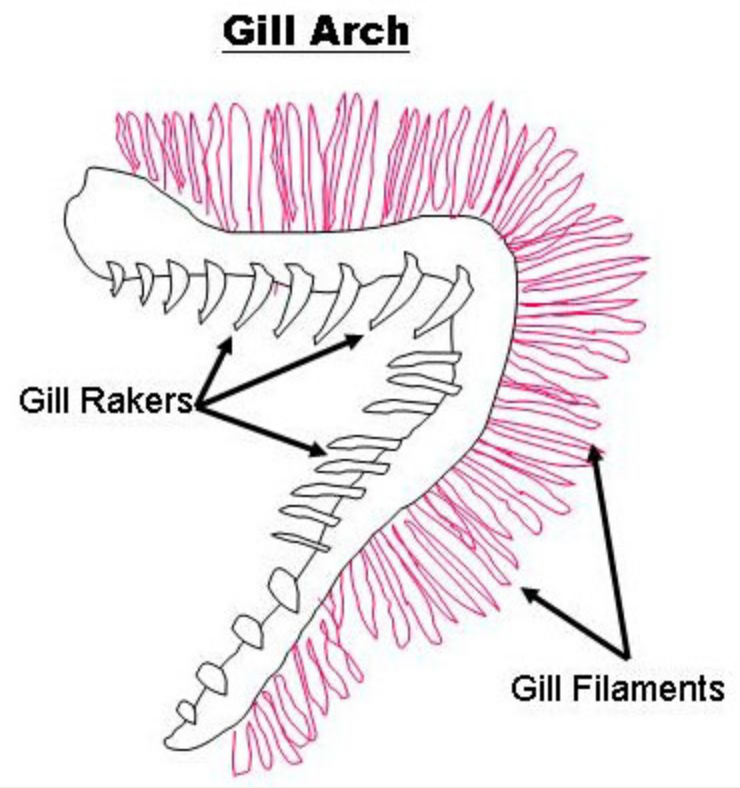
Before this paper, we knew of two feeding methods whale sharks use to eat plankton. One is RAM feeding and the other is active surface feeding. When whale sharks engage in RAM feeding, they swim with their mouths open. Active feeding, on the other hand, involves whale sharks repeatedly opening and closing their mouths, often in a vertical position. Both are common ways for whale sharks to feed, most often at or near the surface.
Check out this video to see the difference.
Bottom Feeding
Thanks to papers by Borrell et al. and Marcus et al., scientists have biochemical evidence that whale sharks are obtaining a large portion of their diet from benthic or deep water habitats. Finally, in Baja California Sur, Mexico, a GoPro captured one juvenile whale shark (5 meters/15 feet in length) bottom feeding in about 6 meters/20 feet of water. The paper describes the shark to slow down, arch its pectoral fins, and lower its head to the bottom at almost a 90 degree angle. Upon contact with the bottom, the shark engages in repeated sucking motions similar to active surface feeding. Not only does the shark intake seawater, but also sand!
Check out the video at the top of this page for the actual video behind this paper, or check out these images of the whale shark bottom feeding:

What was the whale shark eating?
While the answer remains unclear, scientists speculate based on Borrell et al. and Marcus et al. that the whale shark was targeting benthic amphipods. Amphipods are incredibly protein rich and abundant in the Pacific waters of Baja. They also serve as a massive source of food for grey whales.
Using these two papers as evidence, scientists also concluded this is not a random event by a juvenile whale shark, but a scientifically viable feeding method. Based on the reliability of biochemical analysis and how little we know about whale sharks, I agree. I also wonder if this behavior is only common in juveniles or continues into adulthood. Given the nutrient dense composition of amphipods and the growing needs of juvenile sharks, I wonder if the adults bottom feed as much as juveniles. We may not have answers to these questions for several years due to the elusiveness of whale sharks and the deep sea, but I am confident future research will let us know.

Scientists remain unsure of why whale sharks engage in bottom feeding. On the one hand, bottom feeding could be routine but hidden in deep water. On the other hand, bottom feeding could indicate a shift in feeding strategy where planktonic food sources are scarce.
Significance
Beyond cool whale shark facts, establishing bottom feeding in whale sharks directly links them to the benthic environment, which is huge for understanding nutrient cycling. This is also significant because whale sharks have been at risk of ingesting plastics through surface feeding. However, revealing bottom feeding by whale sharks signals a higher risk of plastic ingestion because most of the plastic we put in the ocean sinks to the bottom.
Is this a credible study? My critiques
Unlike other scientific papers, this study has no methods section. It simply scientifically recounts the significance of tourist GoPro footage in context of prior scientific literature. I have no critiques and am extremely happy to share these results with you!
Thanks for reading and I'll see you for the next scientific paper! Have a suggestion? Let me know here.
About this paper:
Year published: 2023
Journal: Fish Biology
Authors: Darren A. Whitehead, Joal Gayford
Place Studied: Baja California Sur Mexico
READ THE FULL PAPER HERE
Links to abstracts of 2 other papers mentioned in this post:


Comments